
Build stronger teams through better decisions.
Life Capital helps organizations find the values that unite their people and turn a group into a team that performs. In a facilitated simulation, six to eighteen people make resource decisions under time pressure, with limited information and competing goals. The last part of the session takes apart what they decided and why, and the team writes down what to change.
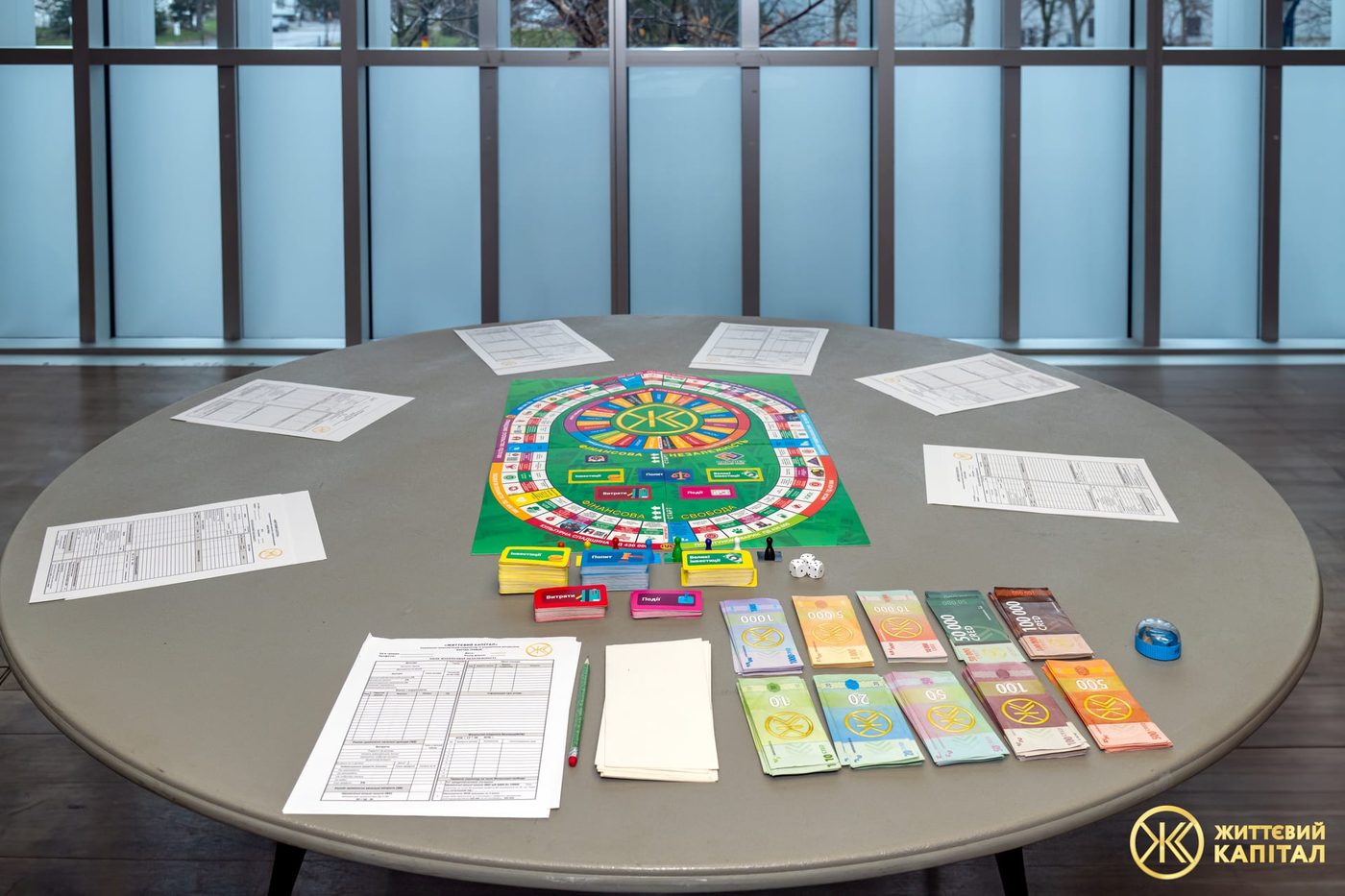
A certified Trainer facilitates the session, and a Banker pays out and collects the money. Each player writes every move into their own ledger.
In the session participants learn to:
- build effective partnerships;
- align personal goals with the organization’s goals;
- communicate and cooperate better;
- manage resources;
- make strategic decisions under pressure;
- bring hidden strengths and leadership to the surface.
Each participant draws a Player Legend face down: a profession and a starting budget. Nobody hands Legends out. Everyone plays their own position, but the resources on the table are finite and the goals conflict — so the session turns into negotiation almost immediately, without anyone being told to negotiate.
In the simulation participants make decisions with visible consequences: allocate or hold, invest or wait, take on obligations, absorb a shock they did not plan for. Team dynamics become visible. Some cards ask for a decision, others you simply carry out. Each player writes every move into their own ledger, so at the end there is a record of what each person did, in their own hand. The Banker pays out and collects the money.
The last block is the retrospective: roles are named out loud, the points where communication broke are located on the board, and the group writes the improvements down. The Trainer facilitates the whole session, from the briefing to the last minute of the debrief. Every part of it matters: nobody can say at which move the insight will come, because it depends on the player and happens with the player.
| Output | Form it takes |
|---|---|
| Agreed principles for making decisions | written, in the team's own words, from the retrospective |
| Role map and the “red zones” of communication | who does what, and where it broke during play |
| 5–7 actionable process improvements | a backlog the team wrote itself, with owners |
The session itself is a board, a ledger per player and a Trainer. The Trainer’s observations of roles and cooperation are offered for the team’s own discussion; the session produces no individual scores.
| Your situation | Session focus | Time | Group | Output |
|---|---|---|---|---|
| Roles overlap; the same decisions get re-made | Team session | 5 h | 6–18 | role map, decision principles, improvement backlog |
| Financial literacy as a staff benefit — personal and family budgets | Standard session | 5 h | 5–8 per table | personal resource map and plan for each participant |
If your problem is not on this list, say so in the enquiry. If a session is the wrong tool for it, we will say so on the call.
- Enquiry — form or email. Tell us the team size, the task you want the session to work on, and the window of dates.
- A 30-minute briefing call. This is the only preparation we need from you: what the team does, what is going wrong, what you want to be different afterwards. Out of this we agree the 2–3 metrics to check before and after.
- A written offer: scenario, group size, date, what we bring, what you provide (a suitable room and a coffee break at half-time), price.
- The session.
- The retrospective document — the outputs above, in writing, sent to you.
- The re-check, on the metrics agreed at step 2, on the date agreed at step 2.
Lead time, cancellation terms and travel for the Trainer are set out in the written offer.
Practical questions HR asks first
How much preparation do we need to do?
A 30-minute briefing is all it takes; participants come to the session as they are.
Can it run online?
No. Life Capital runs in person only: the board, the cards and the money are on a real table.
What do we need in the room?
The session runs at your premises. You provide a suitable room and a coffee break at half-time: tables that seat 5–8, chairs, a whiteboard. We bring the boards, cards, chips and markers.
Can you run it in English and Ukrainian?
Yes. The methodology was written in Ukrainian and has a full English version. Ask in the enquiry if you need another language.
How do we prove it worked?
By the metrics you and we agree in the briefing, measured before and re-checked after. The number depends on what you chose to measure, so every team gets its own figure.
What does it cost?
Until 31 October 2026: CAD 150 a seat, CAD 100 each for two or more. From 1 November 2026: CAD 200 a seat, CAD 150 each for a pair, CAD 1,000 for a whole table. Scenario-based corporate sessions are priced individually, depending on the client's task; the figure comes in the reply to your enquiry, before the briefing call.
Open sessions are CAD 200 a seat, CAD 150 each for a pair (from 1 November 2026). Scenario-based corporate sessions are priced individually, depending on your task. The prices page has the full price list.
Book a Corporate Program
- Confirmation on screen; a person replies from info@lifecapital.ca.
- That reply offers times for the 30-minute briefing call.
- After the call — a written offer with price, date, group size and what each side provides. If a session is not the right tool for your problem, you hear that on the call, free of charge.