
Grade 10 Financial Literacy Practice Test: 14 Questions with Worked Answers
Fourteen questions in the style of everyday money decisions, two for each topic TVO names for Ontario’s Grade 10 financial literacy requirement, each with the working shown, and a score sheet that tells you which topics to review.
This Grade 10 financial literacy practice test has 14 questions, two for each of the seven topics TVO names: budgeting, interest rates, earning and saving, taxes, credit and debt, consumer awareness and financial fraud. Each has a worked answer. Ten right out of fourteen is 71%, just above Ontario’s 70% pass mark.
Life Capital wrote the questions for practice at home or in class. The official modules and test questions are developed by TVO and run by the school (ontario.ca), and TVO publishes its own practice assessments (TVO Learn).
Published 22 October 2026, updated 30 October 2026 · Life Capital, Carleton Place, Ontario · Українською · En français
Score sheet by topic →Practise all seven at one table in Ottawa →
Date, marks and retakes: how the TVO financial literacy test works · the graduation requirement in plain language · results, second attempt and options.
How to use the questions
- Answer all fourteen on paper first, with a calculator if you like.
- Check each answer against the working, and fill in the score sheet by topic below.
- Go back to those topics in the prep checklist and in the TVO Learn practice assessments.
The count by topic shows which ones need another look before the attempt at school.
1. Budgeting
Question 1: a month on a part-time job
Maya is 16 and takes home $640 a month from a part-time job. Each month she pays $45 for her phone plan, $90 for a transit pass, $160 for lunches and snacks, $80 for clothes and $20 for streaming. She wants to put $150 a month into savings. Does the plan work, and how much is left over?
Answer. Her spending adds up to $395 ($45 + $90 + $80 + $20 + $160), which leaves $245. After $150 goes to savings, $95 a month is left unplanned, so the plan works. The phone plan, transit pass and streaming are fixed costs that stay the same each month. Lunches and clothes are variable costs, and they are where the budget can bend if something changes.
Question 2: rent and the 30% line
A household earns $6,000 a month before tax and pays $2,100 a month in rent. Statistics Canada counts housing as unaffordable when it takes 30% or more of before-tax income. Is this household over that line?
Answer. Yes. 30% of $6,000 is $1,800, and the rent is $300 above it. $2,100 / $6,000 = 35% of income. In 2024, 23.2% of Canadian households were over the 30% line (Statistics Canada; our news brief).
2. Interest rates
Question 3: simple or compound interest
You put $1,000 in an account that pays 5% a year and leave it for 3 years. How much is there at the end with simple interest, and with interest compounded once a year?
Answer. Simple interest pays 5% of the original $1,000 each year: $50 × 3 = $150, so $1,150. Compound interest pays 5% on the growing balance: $1,000 × 1.05 × 1.05 × 1.05 = $1,157.63. The extra $7.63 is interest earned on earlier interest, and the gap widens every year the money stays.
Question 4: the cost of a higher rate
You borrow $5,000 for one year with simple interest. How much interest do you pay at 6% a year, and at 9% a year?
Answer. At 6% the interest is $5,000 × 0.06 = $300. At 9% it is $5,000 × 0.09 = $450. Three percentage points more on the rate means $150 more to repay, which is half as much interest again.
3. Earning and saving
Question 5: gross pay to net pay
A pay stub for two weeks shows gross pay of $900. The deductions are $70.00 income tax, $45.00 Canada Pension Plan (CPP) and $14.80 Employment Insurance (EI). What is the net pay? (The deductions are example figures; real amounts depend on the pay, the province and the year.)
Answer. The deductions add up to $129.80, so net pay is $900.00 − $129.80 = $770.20. Gross pay is what the job pays; net pay is what reaches the bank account.
Question 6: a savings goal with a date
A laptop costs $840. If you save $120 a month, how many months until you can buy it? How much would you need to save each month to buy it in 4 months?
Answer. $840 / $120 = 7 months. To buy it in 4 months you need $840 / 4 = $210 a month. A savings goal works best with both numbers written down: the amount and the date.
4. Taxes
Question 7: Ontario HST at the till
In Ontario the harmonized sales tax (HST) is 13%. Headphones are priced at $60 before tax. What do you pay at the till?
Answer. The tax is $60 × 0.13 = $7.80, so you pay $67.80. The 13% Ontario rate is published by the Canada Revenue Agency (CRA GST/HST rates). Shelf prices in Ontario usually show the amount before tax, so the total at the till is higher.
Question 8: why net pay is smaller
Why is the amount in your bank account smaller than the gross pay on your pay stub?
Answer. The employer deducts income tax, Canada Pension Plan contributions and Employment Insurance premiums from each pay before paying the rest, and sends those amounts to the Canada Revenue Agency (CRA payroll). Other deductions, such as a union fee or a benefits plan, can appear on some pay stubs too.
5. Credit and debt
Question 9: where a card payment goes
Your credit card balance is $1,200 and the card charges 19.99% a year. This month you pay $40. Roughly how much of the $40 is interest, and how much reduces what you owe?
Answer. One month of interest is about $1,200 × 0.1999 / 12 = $19.99. So roughly $20 of the payment covers interest and only about $20 reduces the balance. Dividing the yearly rate by 12 gives an estimate; the card agreement sets the exact method. Paying only a small amount each month keeps a balance alive for years.
Question 10: credit scores and reports
What is a credit score, and who might look at your credit report?
Answer. A credit score is a number built from your credit history. In Canada scores usually range from 300 to 900, and a higher score is better. The two main credit bureaus are Equifax and TransUnion. Banks, credit card companies, phone and internet providers, insurance companies, employers and landlords are among those who may request to see your credit report (Financial Consumer Agency of Canada).
6. Consumer awareness
Question 11: two phone plans
Phone plan A costs $35 a month with no other fees. Plan B costs $25 a month plus a one-time $120 connection fee. Which is cheaper over 12 months, and over 24 months?
Answer. Over 12 months both cost $420 (A: $35 × 12; B: $25 × 12 + $120). Over 24 months plan A costs $840 and plan B costs $720, so B saves $120. The one-time fee is paid back after 12 months; compare plans on total cost over the time you will keep them.
Question 12: unit prices
A 500 g box of cereal costs $4.50 and a 750 g box costs $6.00. Which is cheaper per 100 g?
Answer. The small box costs $4.50 / 5 = $0.90 per 100 g. The large box costs $6.00 / 7.5 = $0.80 per 100 g, so it is cheaper per gram. The larger size is a saving only if you use it before it goes stale.
7. Financial fraud
Question 13: a “CRA refund” text
A text message says: “CRA: you have a $412 refund waiting. Claim it here” with a link. What should you do?
Answer. Leave the link alone and delete the message. The Canada Revenue Agency says it will not use text messages or instant messaging such as Facebook Messenger or WhatsApp, and it will not send refunds by e-transfer or text message; it sends texts only as sign-in codes to people who chose that option (CRA scam alerts). Check any refund by signing in to CRA My Account directly.
Question 14: an offer to double your money
An online ad promises to double your money in 30 days and asks you to pay with gift cards or cryptocurrency. What are the warning signs?
Answer. Three signs at once. Doubling money in a month is a 100% return in 30 days, and any offer that promises a high return with certainty is a red flag, because higher returns come with higher risk. Payment by gift cards, prepaid credit cards or cryptocurrency is on the CRA’s list of methods scammers demand (CRA scam alerts). And pressure to act fast leaves no time to check who is behind the offer.
Score sheet: which topics to review
Write down how many of the two questions you got fully right for each topic. A topic at 2 of 2 is ready; at 1 or 0, go back to the worked answers, then to that topic in the prep checklist for the TVO test and the practice assessments on TVO Learn.
| Topic, questions and your score | Review if under 2 of 2 |
|---|---|
| Budgeting Q1 and Q2 · score __ / 2 | Fixed and variable costs; the 30% shelter line from Statistics Canada |
| Interest rates Q3 and Q4 · score __ / 2 | Simple and compound interest; how the rate changes the cost of a loan |
| Earning and saving Q5 and Q6 · score __ / 2 | Gross and net pay; a savings goal with an amount and a date |
| Taxes Q7 and Q8 · score __ / 2 | 13% HST in Ontario; income tax, CPP and EI on a pay stub |
| Credit and debt Q9 and Q10 · score __ / 2 | Monthly interest on a card balance; what a credit score is used for |
| Consumer awareness Q11 and Q12 · score __ / 2 | Total cost over the life of a plan; unit prices |
| Financial fraud Q13 and Q14 · score __ / 2 | How the CRA does and does not contact you; promised returns and gift-card payments |
Add the seven scores for a total out of 14. Ten or more is 71% or higher. The count is a guide to your weak topics; the provincial result comes from the TVO modules at school, and the school offers support between the two attempts.
For parents: from the score sheet to a practice session
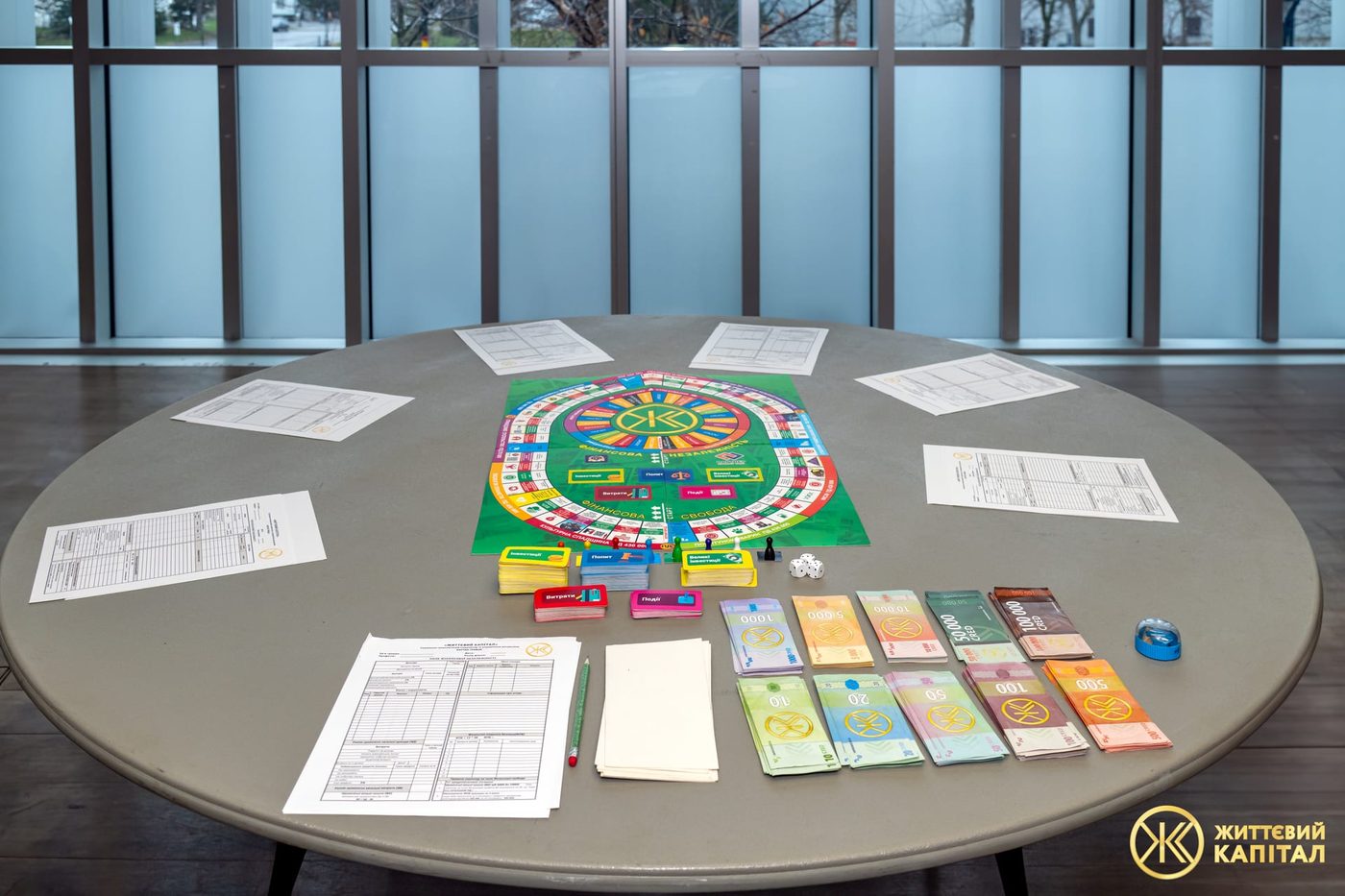
The score sheet shows which topics need another look. A worksheet checks one answer at a time; in a Life Capital session the same topics arrive together: each player keeps a paper ledger through about forty years of a simulated life, borrows, saves, invests and absorbs whatever the cards deal, with a Trainer facilitating the whole session and a Banker who pays out and collects the money. The debrief closes the session, with each player reading their own ledger aloud and saying what each decision cost.
Open sessions in Ottawa and Eastern Ontario run five hours from 13:00, usually at a weekend, for teens from 14 and adults, in English or Ukrainian, with up to eight players at a table. A date is agreed in the reply to your enquiry. From 1 November 2026 a seat is CAD 200, CAD 150 each for a pair, and CAD 1,000 for a whole table; schools book the school club across the school year.
Ask for an open-session date →The Ottawa workshop for teens →
Prices for a seat, a pair and a whole table are on the pricing page; teachers can see the school club for Ontario schools.
Sources
- Ontario: Financial literacy education in schools (updated 14 October 2026)
- Ontario Schools, K–12: diploma and certificate requirements, section 6.1.4
- TVO Learn: Financial Literacy Graduation Requirement
- Canada Revenue Agency: GST/HST rates by province
- Canada Revenue Agency: payroll deductions
- Financial Consumer Agency of Canada: credit report and score basics
- Canada Revenue Agency: scam alerts (page dated 9 October 2026)
- Statistics Canada: Housing affordability in Canada, 2024 (released 21 September 2026)
After the practice test: a session in Ottawa or a club at school
The TVO modules, the questions and the mark stay with the school. Life Capital adds a table where the same seven topics turn into decisions a teenager makes and then explains.
Questions about the practice test
Are these the questions on the real TVO test?
These are Life Capital’s own practice questions on the seven topics TVO names. The official learning modules and test questions are developed by TVO and provided to schools to administer.
Where are the official TVO practice assessments?
On TVO Learn, on its Financial Literacy Graduation Requirement page, next to the learning modules. Ontario’s page for parents points to TVO Learn for materials that prepare students for the requirement.
What score on this practice test matches the 70% pass mark?
Ten correct out of fourteen is 71%, just above the 70% Ontario sets. Use the score sheet by topic to see what to review; the provincial result comes only from the TVO modules at school.
Which topics does the practice test cover?
Two questions each on budgeting, interest rates, earning and saving, taxes, credit and debt, consumer awareness and financial fraud: the seven concepts TVO names for the requirement.
What should a student do after a low score on one topic?
Rework the two questions from the worked answers, then review that topic in the prep checklist and on TVO Learn. Before a second attempt, Ontario says students can use TVO Learn resources and supports from the school.
Where can a teen practise these topics in Ottawa?
At a Life Capital open session in Ottawa and Eastern Ontario: five hours from 13:00, usually at a weekend, for teens from 14. From 1 November 2026 a seat is CAD 200, or CAD 150 each for a pair.